
America’s Non-Places
How Corporate Spaces Erode Recognition and Freedom


By Evelyn Quartz
We live our lives in a series of non-places. Take a road trip and you can cross hundreds of miles without encountering anything that meaningfully signals where you are. The same standardized blue sign with the words FOOD, FUEL, LODGING in white letters appears alongside half a dozen icons of global conglomerates: McDonald’s, Starbucks, Chevron, Hilton, KFC, Holiday Inn. You take the exit only to be blinded by neon floodlights. Throughout the journey — crossing geographic terrains and state lines — the scene is hauntingly repetitive.
The term “non-places” was coined by French anthropologist Marc Augé. A non-place is defined against what Augé calls an anthropological place — a relational, social space. A locally operated diner, for example, has “regulars,” people who may occupy the same table every week and know each other’s names and histories. It’s somewhere people go to feel a sense of know-how specific to place and community. Children and parents may run into other families from school; clerks may recognize customers; there’s a sense that people know one another. While all of these experiences may happen at a corporate chain restaurant such as McDonald’s, Augé argues the space isn’t designed for it. Instead, it functions as an interface, where the customer is a standardized unit — a place where you are often alone and simultaneously “one of many,: and where one trades the identity of a community member for the role-playing identity of a consumer. Augé acknowledges that while these places provide convenience — and even the pleasures of anonymity — they are not organically social spaces but reproductions of them: spectacles.
These spaces are a product of what Augé calls “supermodernity,” a period marked by mass consumption, digital life, and an excess of time, space, and individualism. His observations about excess are important. The news, hypersaturated by “breaking news” alerts, leaves us little time to process events and creates a fractured, selective understanding of reality. In a hyperconnected, globalized world, spaces are designed for transit, producing the feeling of passing through an excess of places without meaningful connection to any one of them. The individual inhabiting the world of supermodernity is a “user” of contractual relations — a consumer, a passenger, a credit card holder. It is this oversaturation of information, images, and non-places that sets us up to be consumers rather than relational beings.
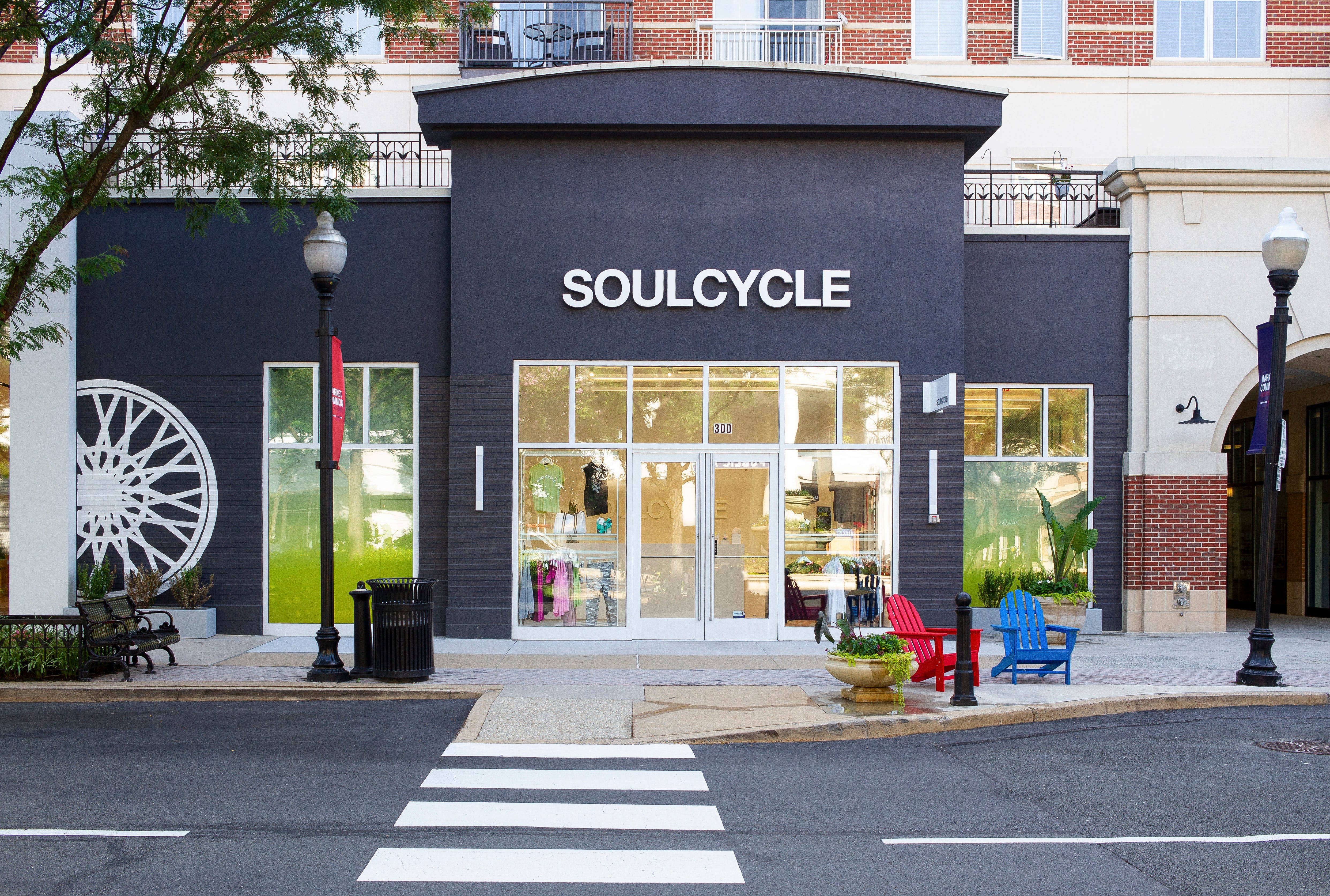
Recently in Los Angeles, I was visiting some friends in Venice Beach. “You have to go to the east side of L.A. to find anything cool,” they told me. “There’s too much sameness here.” I knew exactly what they meant. I’d experienced it in other cities. In Washington, D.C., 14th Street was once the heart of Black Washington and now hosts the same “SoulCycle corridor” as Venice. Williamsburg, Brooklyn — once a landing point for new immigrants, Jewish, Puerto Rican, Ukrainian, Polish — has fallen to the same phenomenon. Along with SoulCycle, the stationary bike fitness studio owned by the $7 billion global fitness company Equinox Group, these neighborhoods are home to chains like Whole Foods, Lululemon, and Sweetgreen. The businesses play the same role as a corporate highway park full of Walmarts, Starbucks, Chick-fil-A, Marshalls, and Olive Gardens. They are simply filtered, rebranded, and priced for a wealthier class.
Coffee brands such as La Colombe, Blue Bottle Coffee, and Intelligentsia are staples in these urban corridors. They are products of the “craft” craze of the mid to late 2000s, which ironically turned a fixation with localism into an aesthetic that could be packaged and branded across geography. La Colombe started as a small-batch roastery in the 1990s in Philadelphia and was bought in 2023 by the food giant Chobani for $900 million. Blue Bottle, which derives its name from the original Viennese coffee shops of the 1600s, began in Oakland in the early 2000s before Nestlé acquired a majority stake in the company. Intelligentsia and Stumptown have similar stories and have both been acquired by Peet’s Coffee & Tea. Here, what started as “anthropological places” rooted in community has morphed into non-places — standardized copies of what was once authentic, designed to fit a commercialized aesthetic.
In 2005, Google moved into Venice, leading the area to be dubbed “Silicon Beach.” The constant sunshine and proximity to Hollywood—the same dream that once lured the hippies — now drew investors with their startups and “accelerators,” and visions of “online marketplaces.” Silicon Beach, which includes neighboring Playa Vista and Culver City, is now home to over 500 tech companies, including Google, Amazon, and Snapchat.
The area’s famous street, Abbot Kinney, retains a few local spots dating back to the 1990s — Abbot’s Pizza Company and the artist space Hamilton Press Gallery — but these are overshadowed by the same dozen “lifestyle” brands developed for the professional class. SoulCycle promotes its abundance of locations as a perk for the global elite: wherever you go, you can catch your morning spin class with the same predictable routine. Afterwards, you can mobile-order your favorite $16 salad from Sweetgreen or pick up a new pair of yoga pants at Lululemon. For a globalized professional class, this routine can be carried out in half a dozen major American cities. The illusion, as Augé captures, is that you don’t have to be a traveler to experience this. You can live in one of these cities and still experience the same sense of being in transit — floating not as a resident with local ties and roots in a neighborhood, but as a consumer, an individual with credit card points and loyalty status, all at the tap of a digital wallet.
This helps explain why moving through American life in the 21st century can feel repetitive, dull, and even soulless. In the exurbs, residents pile into their cars for a weekly shopping trip to the same handful of corporate big-box stores. Many have abandoned this routine altogether, opting instead for doorstep delivery services for basic goods like groceries, appliances, and clothing. Some of these products arrive through Amazon, the world’s largest online retailer, valued at over $2.5 trillion. Others come via third-party delivery apps like DoorDash, Uber Eats, and Grubhub. These apps offer “contactless” delivery, in which the driver leaves the order at the door and uploads a photo to the app — an arrangement that takes to its extreme Augé’s concept of solitary contractuality, where social interaction is replaced by the machine.
Americans never consented to live like this. Instead, the corporate takeover of everyday life was facilitated by policy choices made in the 1980s and 1990s by a technocratic, bipartisan class increasingly unmoored from democratic accountability. I’ve written more about this process for the Blue Dog Bark in a piece on globalization. For Augé, globalization is the transformation of political economy that produced supermodernity. In this globalized technocratic landscape, citizens become users of the infrastructure of everyday life. Our daily experiences — withdrawing money at the bank, ordering a meal, purchasing home goods — are increasingly conducted over screens, or mediated through the human face of a corporate entity. We’ve all experienced this mundane ritual at the checkout lane of a supermarket, in the predictable, often robotic “how are you” and “have a good day.” What results is an eerie simulation of social life in which human recognition is reduced to a standardized user experience.
The German philosopher Hegel argued that recognition — the experience of being “seen” by others as a full participant in a shared social world — is the foundation of human freedom. This requires social and relational life. In other words, people must be someone to each other; they cannot exist as interchangeable units. A supermarket cashier, for example, must be part of the social fabric of a place where others encounter and recognize them as a human being, not merely for their commercial or labor value.
The transformation of society into non-places has left public life devoid of meaning. Recognition — the most basic source of our shared humanity — has become secondary to a system in which we are constantly acknowledged as consumers and rarely known as people. What is at stake is far greater than charm or localism; it is the conditions under which people come to recognize one another as equals in a shared world.
 | A guest post by
|